The other day I got a call from someone concerned their car was shaking violently when braking. They couldn’t figure out why it was happening and it was starting to worry them.
Common symptoms could be
- Steering wheel vibration when braking
- Pulsation through the brake pedal
- Whole car shaking when braking
- Vibration that gets worse over time
So let’s list a few things that could cause this, how it might happen and what to do when it does.
Worn Brake Components
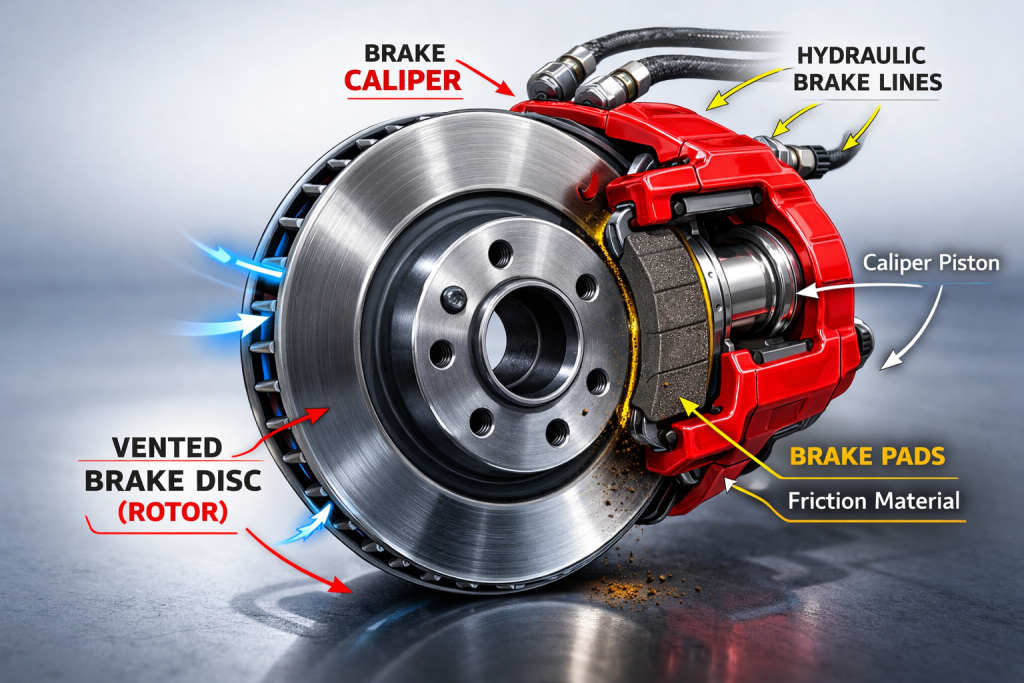
The most common reason is worn braking components that are simply out of shape. A brake rotor is a circular disc to which brake pads are pressed against using a hydraulic caliper.
When you press the brake pedal, the caliper squeezes the pads against the rotor.
If the rotor is uneven or what’s often called “warped” when the brake pads come in contact with it as the wheels are turning it will transfer that unevenness into a pulsation that will be felt through the car.
What people often call a ‘warped rotor’ is usually uneven thickness or pad material buildup on the rotor surface.
You may even feel it in your foot through the brake pedal. The more severe the warp in the disc the more violent the shake will be.
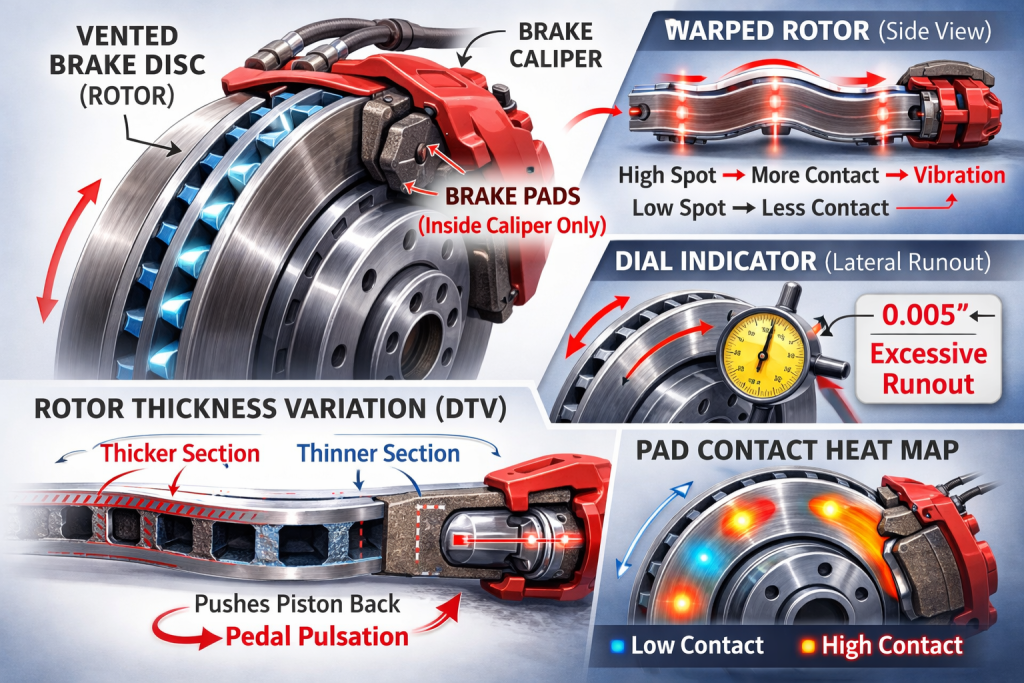
Taking a look at this photo that Chat GPT gave me when I explained what I was trying to show, you can see the brake friction pad and how it comes in contact with the rotor. Any high and low spots will cause that shake you’re feeling.
The way a mechanic can measure this run-out or unevenness is with a dial gauge. We do this by pre-loading the gauge against the rotor face and turning it by hand as we watch the gauge for measurement fluctuations.
Maximum run-out/unevenness is usually somewhere around 2 to 3 thou.
That's 0.002" to 0.003" or 0.05mm to 0.07mmA cautionary word here is to also measure the hub run-out after the rotor has been removed. As well as looking for any other worn parts.
I’ve seen a lot of wheel hubs being the fault in this case and it’s only noticed a few weeks later when the customer comes back complaining of the same problem.
The issue now is you’re replacing some wheel bearings, hubs and another set of rotor and pads. That’s not good news for anyone involved.
If it is just a rotor and pad replacement job it is imperative to thoroughly clean all rust and debris before fitting the new parts. I have seen it far too many times where new brakes are fitted to rusted hubs and only a matter of days later they are out of shape again.
Could it be an electrical issue?
The anti-lock braking system is designed to prevent the wheels from locking up under heavy braking and preventing the vehicle from skidding.
It does this by pulsating the braking when the driver is pressing on the pedal trying to stop from speed. Sometimes this can be felt through the pedal as a shake or pulse and it can be unnerving to drivers who haven’t experienced it before. But this is normal.
A key difference is:
ABS issue, usually happens at lower speeds just before stopping
Warped rotor, happens consistently and often worse at higher speeds
The same system can cause pedal pulsations or other odd braking behavior if a part of that system is faulty. The issue here is use of language from a customer to a technician. Normally if the ABS is at fault a light will be on or possibly flashing.

Finding the issue
The vehicle I was called about turned out not to be a brake issue at all.
It had a faulty tone ring on one of the wheels. As the car slowed down, the ABS system was being triggered incorrectly, causing a shaking sensation through the pedal and vehicle.
What made this tricky was that the ABS warning light wasn’t on. It had actually been removed and bypassed by a previous owner.
In our phone conversation I had believed, listening to his description, that the vehicle needed a set of rotors and pads. Thankfully I doubled-checked by recreating the customers concern and running all checks on the braking system including a code scan. A code scan here might be dismissed because it sounds like a straight up mechanical fault, but in this case it was the lead I needed to get this problem sorted. The warning light will be repaired later, requiring a new dash module.
If your car is shaking when braking, don’t assume it’s just worn brake parts. While rotors and pads are the most common cause, issues like ABS faults or hub run-out can lead to the same symptoms.
